
When we are no longer able to change a situation -
We are challenged to change ourselves.
Therapy Services
-
Therapeutic Approach
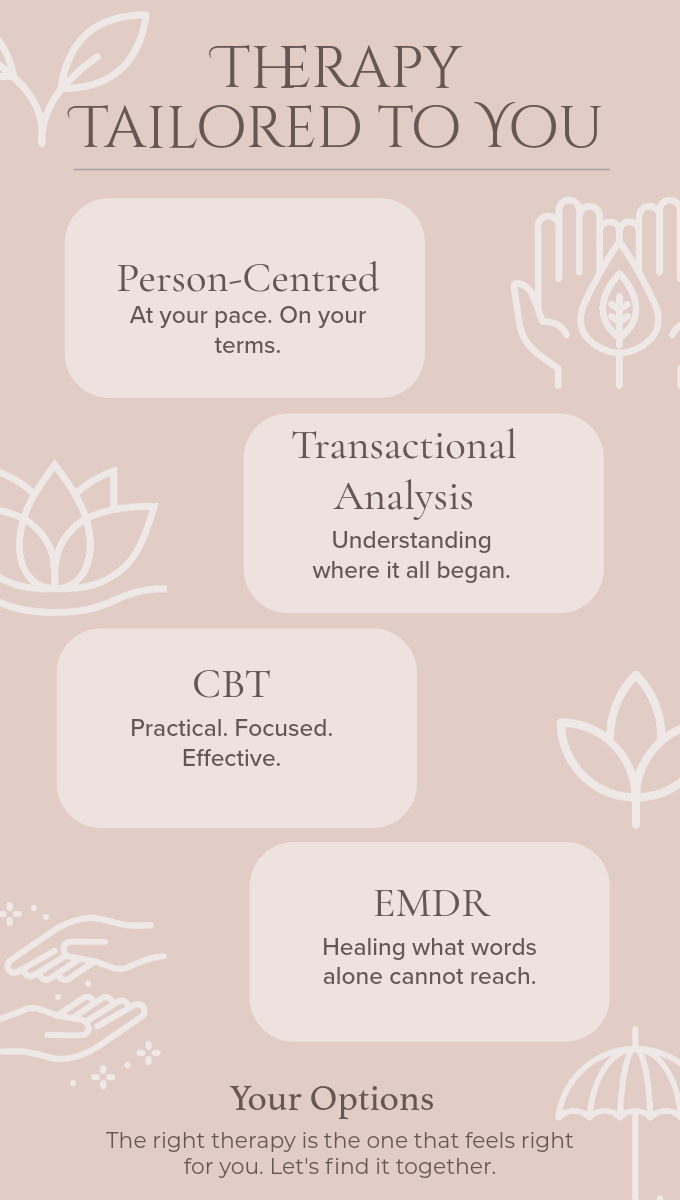
I draw on a range of evidence-based therapies, tailoring my approach to suit each individual client and their unique needs.
Person-Centred Therapy A warm, non-judgmental approach that places you at the heart of the process. We work at your pace, in a space where you feel truly heard and understood.
Transactional Analysis A practical framework for understanding how our past experiences shape the way we think, feel, and relate to others — and how to change patterns that no longer serve us.
Cognitive Behavioural Therapy (CBT) A structured, solution-focused approach that helps you identify and shift unhelpful thought patterns and behaviours affecting your day-to-day life.
EMDR (Eye Movement Desensitisation and Reprocessing) A specialist therapy that helps the brain process past traumatic events that have not been fully resolved. EMDR targets the areas of the brain where difficult memories are stored, working to reduce the distress attached to them. It is widely used for PTSD, Complex PTSD, anxiety, depression, and phobias.
All of my work is rooted in a psychodynamic perspective — the understanding that difficulties in the present are often connected to earlier experiences in life. Whatever you are facing, whether your feelings are clear or hard to put into words, therapy can offer fresh insight and a way forward.
Whatever the approach, the most important part of any therapy is the relationship between therapist and client. That connection is always at the centre of the work we do together.
-
50 minutes. You are free to end your therapy session/course whenever you choose, although it is beneficial to discuss the ending and plan for it during the sessions.
-
Your first session is a gentle introduction. It is a chance for you to share a little about what has brought you to therapy, ask any questions you might have, and get a feel for whether working together feels right for you. There is no pressure — you are in control of what you share and when.
From the second session onwards, we begin the therapeutic work at a pace that suits you. Every session is different, but you can always expect a safe, confidential space where you feel heard without judgement.
-
50 minutes. You are free to end your therapy session/course whenever you choose, although it is beneficial to discuss the ending and plan for it during the sessions.
-
Once appointments are scheduled you will be expected to pay, unless you provide one week in advance notice of cancellation. This, of course, excludes emergencies and exceptional circumstances.
Therapy Step by Step starting the process
Get in touch
Step 1Simply send an enquiry, and Deborah will be in touch to arrange a free introductory call.
Your free introductory call
Step 2(15–30 minutes) This is a relaxed, no-obligation conversation. It is a chance to share a little about what has brought you to therapy, ask any questions, and get a feel for whether working together feels right for you. Tip: Take a few quiet minutes beforehand to reflect on what you'd like to discuss. Have your diary to hand in case you'd like to book a first session.
Your first session
Step 3If you feel ready, we confirm whether sessions will be in-person or online and arrange your first appointment. You'll receive the address or contact details ahead of time.
The work begins
Step 4From your first full session, we begin at a pace that suits you — in a safe, confidential space with no judgement.
There is no obligation at any stage. A good connection between therapist and client matters, and it is completely natural if the fit isn't right.
Your Initial Consultation

Your first session is different from all the ones that follow. Rather than diving straight into therapeutic work, it is simply a chance for us to get to know each other.
You are welcome to ask me anything — about my experience, my approach, or how the process works. At the same time, I will gently ask you some questions to better understand you and what has brought you here.
The kinds of things we may talk about:
We will explore what has led you to seek therapy, and what you are hoping to get from it. I may ask about your life more broadly — your relationships, your home life, your history, and any past experiences that feel relevant. This can include your childhood, your family, and significant life events.
Some questions may feel personal. I may ask about your mental health history, whether you have experienced therapy before, and whether you have ever had thoughts of harming yourself. These questions are asked with care, and only to ensure I can support you in the best and safest way possible.
By the end of the session, we will:
Have a clearer picture of what you would like to work on
Have discussed whether in-person or online sessions suit you best
Have agreed on session frequency and length to fit your schedule and budget
Have covered confidentiality and how we will work together
From your second session onwards, the work begins — often picking up on something meaningful that came up in that first conversation.
After Your First Session

Once your first session is over, the most valuable thing you can do is simply check in with yourself.
Therapy is a deeply personal process, and your feelings afterwards are worth paying attention to. You might feel relieved, a little emotional, or even unsure — all of that is completely normal.
A few gentle questions to reflect on:
How did the session feel overall?
Did you feel comfortable talking with me?
Can you imagine us working together over time?
There are no right or wrong answers. What matters is that the relationship feels safe enough for you to open up — and that takes time to build. Trust develops gradually over several sessions, and the first is just the beginning of that process.
It is also worth remembering that meaningful change does not happen overnight. You may leave your first session feeling lighter, but the deeper work unfolds over time. That is not a sign that therapy isn't working — it is simply how the process goes.
Between sessions I may occasionally suggest something small to do before we next meet — perhaps keeping a brief diary, or doing a little reading to add context to what we have discussed. Anything I suggest is simply there to support your progress and help you feel a little better in your day-to-day life.
Terms & Conditions
All enquiries are strictly confidential and you do not need a GP referral to make an appointment. To set up an initial consultation or to discuss any questions or concerns you may have, please use the contact page.
Privacy Statement
I am committed to ensuring that your privacy is protected. If you make contact with me, I may collect the following information: Name, Contact details – address, telephone number and/or email, GP’s details (where applicable), D.O.B (where applicable).
I am committed to ensuring that your information is secure. In order to prevent unauthorised access or disclosure, I have procedures to safeguard and secure the information I collect.
I will not distribute your information to third parties. If data is shared, it is only with the consent of the client involved or if I am required to do so by law.
My website may contain links to other websites of interest. However, once you have used these links to leave my site, I do not have control over these websites and cannot be responsible for the protection and privacy of any information which you provide.
If you would like any further information, please enquire via the contact page